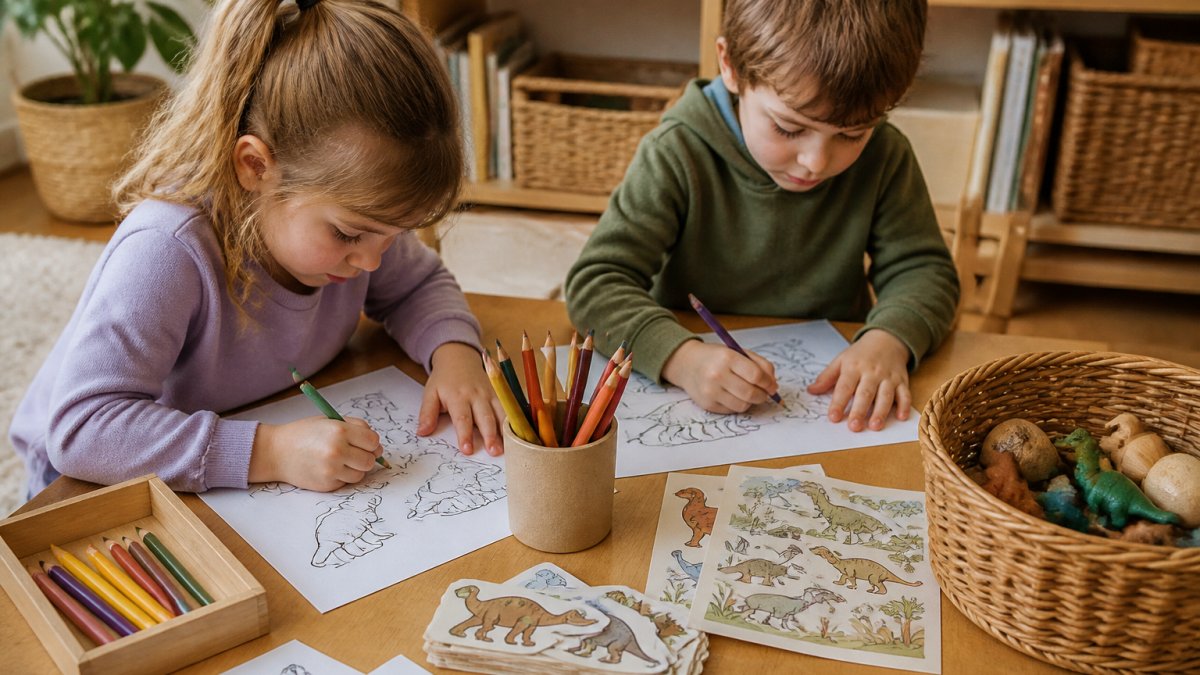
 ultimate-guide
Engaging Screen Free Activities for Children: 2026 Guide
Table of Contents
- Why Screen Free Activities Matter for Children
- Screen-Free Activities for Toddlers
- Indoor Activities for Children on Rainy Days
- Printable Activities for Children: Creative and Calm
- Age-Appropriate Screen-Free Activities for Every Stage
- Building a Screen-Free Routine That Sticks
- What to Ignore: Common Bad Advice About Screen-Free Play
- Conclusion
- Frequently Asked Questions
Last Updated: 9 October 2026
Why Screen Free Activities Matter for Children
The most valuable thing you can give a child is not another app. It is your attention, a table, and something to do with their hands. At Roarora, we build dinosaur-themed printable storybooks and colouring packs for exactly this reason: children aged 3 to 8 learn best when they are creating, moving and imagining rather than watching.
This guide to engaging screen free activities for children is built around one argument: the goal is not to remove screens and leave a vacuum. It is to fill the time with something better. A bored child handed a colouring page will engage for a few minutes. A child handed a story about a dinosaur who feels anxious, plus crayons and a job to do, will stay for far longer.
Below, we break activities down by age, setting and energy level, so you can pick something that fits the child in front of you rather than the average child in a book.
Screen-Free Activities for Toddlers
Screen-free activities for toddlers work best when they engage the senses rather than the intellect. Children aged 1 to 3 are still learning through touch, sound and movement, so the simplest activities tend to hold attention longest.
Sensory Play Ideas for Ages 1-3
Sensory play is any activity that deliberately involves touch, smell, sound, sight or movement. For toddlers, it is the primary way they explore cause and effect.
- Dry sensory bins. Fill a shallow tray with uncooked rice, dried pasta or large oats, and hide small toys inside for the child to find. Supervise closely with anything small enough to swallow.
- Water play. A washing-up bowl on a towel, a few plastic cups and a sponge will occupy a toddler far longer than most toys. Add a drop of food colouring for novelty.
- Playdough squeezing. Rolling, pinching and pressing builds the same hand muscles needed later for pencil control.
- Textured walks. Collect leaves, feathers and smooth stones in a small bag, then let the child sort them by feel.
A common mistake is over-preparing. Toddlers do not need an elaborate setup. They need permission to make a mess in a controlled space.
Simple Movement Games for Little Ones
Movement games burn energy and build coordination. Keep them short, repeatable and low on rules.
- Animal walks. Bear crawl, frog jump, crab walk. Name the animal and do it together.
- Freeze dance. Music on, dance; music off, freeze. No screens required, just a speaker or your own singing.
- Pillow obstacle course. Cushions on the floor to jump over, a blanket to crawl under.
- Ball roll. Sit opposite each other and roll a soft ball back and forth. Simple, but it teaches turn-taking.
Indoor Activities for Children on Rainy Days
Indoor activities for children need to solve two problems at once: limited space and restless energy. The trick is to alternate high-energy bursts with quiet, focused tasks so nobody reaches meltdown point by mid-afternoon.
A workable rainy-day rhythm looks like this:
| Time Block | Activity Type | Example |
|---|---|---|
| Morning | High energy | Indoor obstacle course, dancing |
| Late morning | Focused | Colouring, puzzles, building |
| After lunch | Quiet | Story time, audiobook, drawing |
| Afternoon | Creative | Den building, pretend play, baking |
| Late afternoon | Calm | Mindfulness colouring, gentle music |
Den building deserves a special mention. A clothes horse, two sheets and a few cushions will keep children occupied for an hour, and the den becomes the setting for whatever game follows. It is one of the few activities that works for a 3-year-old and an 8-year-old at the same time, because each child plays at their own level inside the same structure.
Baking is another reliable option, provided you accept that the kitchen will look worse before it looks better. Measuring ingredients teaches early maths, and the wait for something to come out of the oven is a useful lesson in patience.
Printable Activities for Children: Creative and Calm
Printable activities for children are downloadable pages, such as colouring sheets, story pages and puzzle worksheets, that you print at home and hand to a child with pens or crayons. They are cheap, instant, and easy to store.
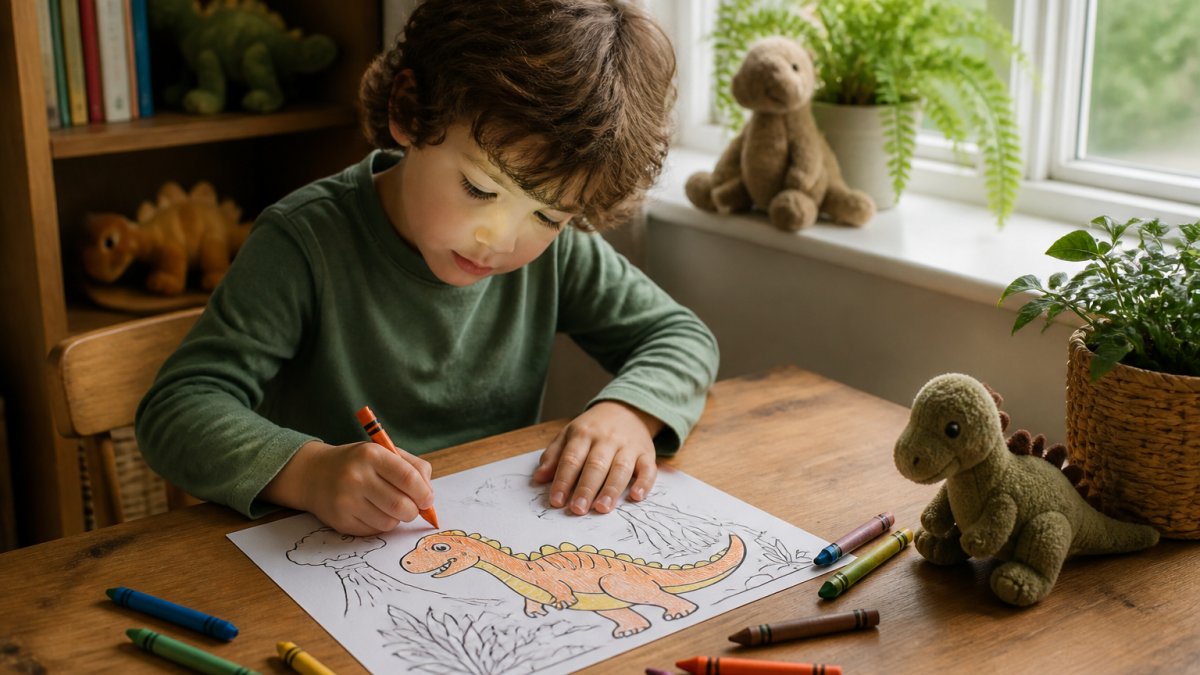
The reason printables work so well is that they remove the hardest part of any activity: deciding what to do. The page is already there. The child just starts.
How Printables Support Independent Play
Independent play is the ability of a child to occupy themselves without an adult directing every step. Printables support it in three specific ways.
First, they give a clear starting point. A blank page invites "I don't know what to draw." A colouring page with a dinosaur on it invites colouring.
Second, they have a natural finish line. The page ends. That gives a child a sense of completion, which is genuinely satisfying at this age.
Third, they scale. A 3-year-old can scribble on a simple outline; an 8-year-old can follow a detailed story page and add their own dialogue. One download serves siblings of different ages, which is why mixed-age families get the most value from them.
Age-Appropriate Screen-Free Activities for Every Stage
Age-appropriate screen-free activities should match both the child's physical abilities and their attention span. The same activity can work across ages, but the expectation has to change.
Ages 3 to 4. Attention span is short, often five to ten minutes per activity. Focus on sensory play, simple colouring, stacking, and songs with actions. Expect to move between activities frequently, and that is normal.
Ages 5 to 6. This is the sweet spot for printables. Children can follow instructions, hold a pencil properly, and start to enjoy completing a task.
Ages 7 to 8. Attention span stretches, and children want more control. Give them a story to finish themselves, a colouring page with fine detail, or a project that takes more than one sitting.
The mistake most parents make is buying for the youngest child and expecting the oldest to be satisfied with the same thing.
For mindfulness specifically, calm-down colouring works across the whole age range, provided the design is simple enough for small hands. The point is not the finished picture. It is the slowing down.
Building a Screen-Free Routine That Sticks
A screen-free routine works when it is predictable, time-boxed and not framed as a punishment. Children resist sudden removal of screens far more than they resist a routine they can see coming.
Start with one protected block per day, not a whole screen-free weekend. Twenty minutes after school, or half an hour before dinner, is enough to begin. Protect that block consistently for two weeks before adding another.
Three things make the difference between a routine that survives and one that collapses:
- The activity is ready before the block starts. Preparation is the parent's job, not the child's.
- The block has a visible end. A timer, or a natural finish such as the end of a page, prevents the "just five more minutes" negotiation.
- You are nearby. Not necessarily playing, but present. Children engage longer when an adult is in the room.
If a child protests at first, that is expected. Hold the boundary gently and keep the activity genuinely appealing. A routine built on boring activities will fail no matter how consistent you are.
For families who want a ready-made option, our printable packs are designed to slot straight into a daily routine: download, print, and the activity is ready.
What to Ignore: Common Bad Advice About Screen-Free Play
Most screen-free advice is well-meaning and wrong. Here is what we would ignore.
"Screen-free means zero screens, ever." This sets an impossible standard and guarantees guilt. The realistic goal is more screen-free time, not a perfect record.
"You need to buy special equipment." You do not. Cardboard boxes, dried pasta, crayons and a printer cover the vast majority of what works.
"Children should entertain themselves completely independently." Independent play is a skill that develops with support. Expecting a 3-year-old to self-direct for an hour is unrealistic and leads to frustration on both sides.
"If they're bored, that's good for them." Some boredom is healthy. Sustained, unrelieved boredom just leads to conflict. The aim is to offer a starting point, not to leave a child stranded.
"Mindfulness activities are only for anxious children." Calm-down colouring and slow breathing help every child regulate, not just those who struggle.
The pattern across all of these: advice that sounds strict or pure usually ignores how children actually behave. Practical, slightly imperfect routines beat ideal ones every time.
Conclusion
The real challenge with screen-free time is not finding activities. It is having one ready at the exact moment a child needs it, before the screen wins by default. That is a preparation problem, and it is solvable.
Roarora exists to make that easier. Our printable storybooks, colouring packs and mindfulness activities feature original dinosaur characters, including Rory, Tilly, Stella, Benny, Ada and Vee, and are designed for children across the 3 to 8 range. Everything is a digital download, so you can print a fresh activity whenever you need one, and our dinosaur gifts make a roar-some present for a grandchild or a birthday.
Get started with Roarora and put a ready-made adventure in front of your child today.
Frequently Asked Questions
What are some engaging screen free activities for children?
There are plenty of options, from sensory play and building with blocks to printable colouring packs and storytelling. For toddlers, try stacking cups or water play. For older children, printable activities for children like dinosaur colouring pages or simple puzzles work well. The key is matching the activity to your child's interests and attention span, then rotating options so nothing feels stale.
How do I keep children entertained without screens?
Variety and routine help. Set out a few activity stations, such as a colouring table, a building corner, and a quiet reading spot. Rotate what is available each week. Printable activities for children are useful because you can print a fresh set whenever interest dips. Also, join in for the first few minutes; your involvement often sparks longer independent play afterwards.
What are the best screen-free activities for toddlers?
Toddlers do well with simple, sensory-rich activities. Try filling a shallow tray with water and plastic cups, making playdough, or sorting large colourful buttons. Board books with flaps and simple songs with actions also work well. Keep sessions short, around 10 to 15 minutes, and follow your child's lead. Screen-free activities for toddlers should focus on touch, movement, and cause-and-effect, not on completing a task.
Which screen-free activities are suitable for different ages?
Age-appropriate screen-free activities change as children grow. Ages 1-3: sensory bins, stacking, and picture books. Ages 3-5: printable colouring, playdough, and pretend play. Ages 5-8: board games, simple crafts, and story-writing prompts. Printable activities for children often include age guidance, so you can pick the right level. If you have a mixed-age group, choose open-ended activities that older children can adapt while younger ones explore at their own pace.
How can printable activities help children spend less time on screens?
Printables give children something tangible to do with their hands, which naturally pulls attention away from screens. A fresh colouring page or a simple puzzle can hold interest for 20 to 30 minutes. They are also easy to prepare: print, grab some crayons, and you are ready. Many printable activities for children include mindfulness elements, like calm colouring or breathing exercises, which help children settle after busy periods.
What are some easy screen-free activities for a rainy day?
Indoor activities for children work best on rainy days. Try a blanket den with books, a kitchen-table craft using paper and glue, or a printable dinosaur adventure pack. You can also set up a simple obstacle course with cushions. If energy is high, put on music and have a dance break. Having a few printable activities for children printed and ready means you always have a backup for wet afternoons.